

Bitcoin price
Sharp drop to ≈ $62,000, which directly reduces mining revenue.
Market update · June 2026
Bitcoin price and mining difficulty remain at the same compressed levels. Hashprice stays too low for a positive variable yield after operating costs.
Current status
Following the communication dated 24 February 2026 regarding the change in the variable rate of the Cloud Mining programme operated by Hearst, a further evolution of the underlying mining activity led to a new reduction of the variable yield from 3% to 0% (communication dated 8 June 2026).
As of summer 2026, the situation remains unchanged: Bitcoin price and network mining difficulty are still at the same point, keeping hashprice compressed and the fleet below break-even.
Market context
Since the February update, the market context deteriorated rapidly and significantly. Combined with persistently unfavourable mining parameters, this drop pushed the fleet’s margin into negative territory.
Sharp drop to ≈ $62,000, which directly reduces mining revenue.

Very high level ≈ 138.96 T (source Newhedge) — increased competition on the network, and difficulty is not easing even as price drops.

Mining revenue per unit of power compressed to ≈ $29 / PH / day (source Newhedge).
Market data
These charts illustrate why profitability shifted from a positive phase in 2025 to a neutral / below break-even phase in 2026 — and why conditions remain unchanged this summer.
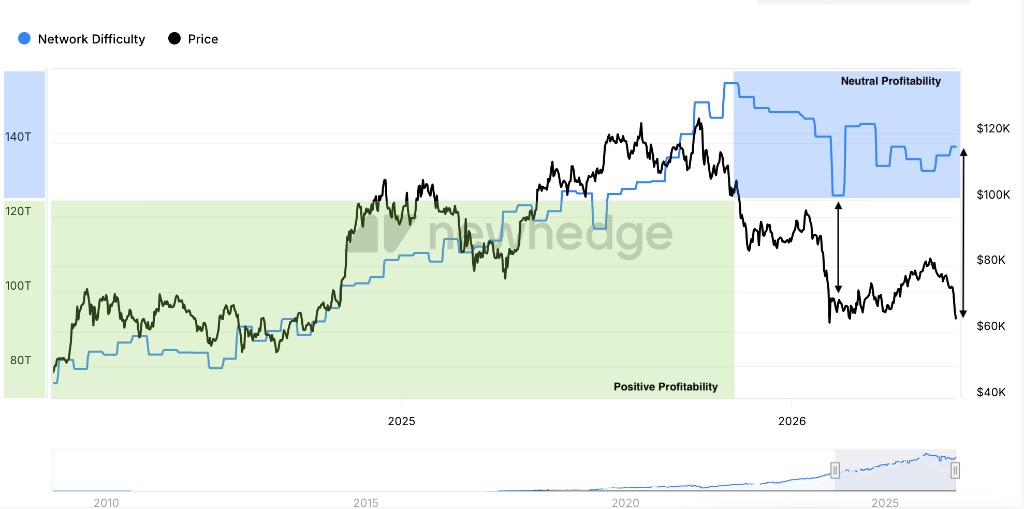
In 2025, rising price supported positive profitability. In 2026, difficulty stayed elevated (~130–140T) while price compressed — leaving a tight, unfavourable gap.
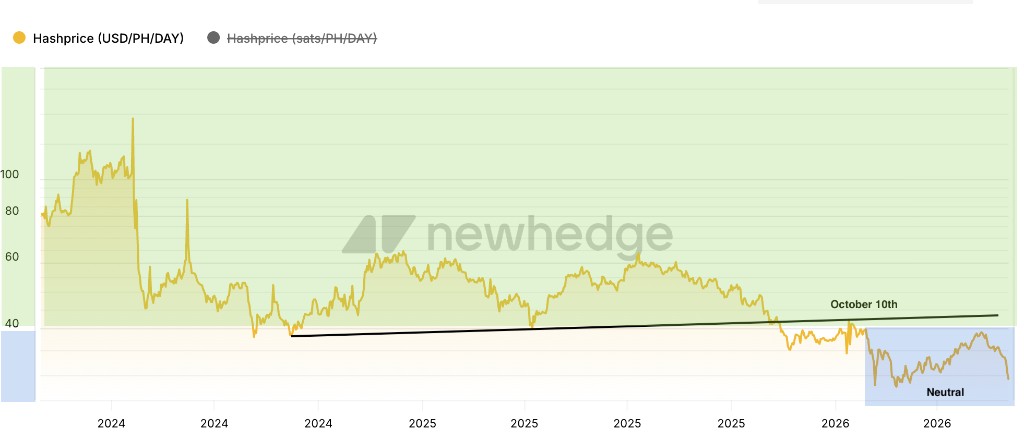
Hashprice fell into a prolonged neutral zone below ~40 in 2026, reaching around $29 / PH / day — too low to distribute a positive yield after operating costs.
Chart sources: Newhedge. Illustrative market context as of June 2026.
To better understand
The Cloud Mining yield depends directly on the profitability of Bitcoin mining. Today the hashprice — revenue generated by miners’ computing power — has fallen to a very low level (around $29 per PH/day). In this context, mining revenue no longer allows, in the short term, a positive yield to be distributed once operating costs are taken into account.
Bitcoin mining difficulty measures how hard it is to produce a new block. At around 138.96 T, a large amount of computing power competes on the network. Each machine receives a smaller share of Bitcoin rewards — in most cases no longer enough to cover operating costs. Combined with a very low hashprice, this significantly reduces Cloud Mining profitability.
The combination of these factors — compressed mining revenue and Hearst operating costs under pressure — has pushed the fleet’s profitability below its break-even point.
Operations
In these market conditions, Hearst is not in a position to keep the mining fleet running with a positive margin. As a matter of responsible operations, and in order to preserve the infrastructure rather than running it at a loss, it has been agreed that Hearst will temporarily pause the fleet, until economic conditions recover.
Preserving the infrastructure today is what allows the programme to fully capture the upcoming rebalancing phase, conditional on more favourable mining parameters.
As a direct consequence of this pause, and in accordance with the Terms and Conditions of the Cloud Mining programme, the distribution of the variable yield is reduced to 0%, with immediate effect.
This measure remains in effect until a recovery in the price of Bitcoin and/or an adjustment of the hashprice allows the fleet to restart under satisfactory profitability conditions. This summer, those conditions have not yet materialised.
Ongoing oversight
Vancelian LTD ADGM, in coordination with Hearst’s operational teams, continues to monitor market conditions and the economic performance of the mining infrastructure.

Tracked continuously as the primary driver of mining revenue.

Key network parameters that determine revenue per unit of computing power.

Energy, supervision and maintenance costs required to run the fleet.
Following this analysis, and in accordance with the Terms and Conditions of the Cloud Mining programme, the applicable yield may be adjusted to reflect the actual economic conditions of the programme and preserve its long-term financial balance.
How rewards work
Hearst provides computing power that is made exclusively accessible to Vancelian users. In return, Bitcoin mining rewards are distributed and converted into EURC, in proportion to the purchase contract. Yield depends on several technical and economic factors.
| Factor | Description | Impact on reward |
|---|---|---|
| Computing Power | Hashrate / Machine efficiency | The higher it is, the more you receive |
| Electricity Cost | Cost per kilowatt-hour | Lower costs = better profitability |
| Bitcoin Price | BTC value at the time of conversion | No direct impact — reward is converted to EURC |
| Mining Difficulty | Adjusted every 2 weeks by the network | Higher difficulty = smaller share per TH/s |
| Hashprice | Revenue per unit of power (TH/s) | Key performance indicator, based on BTC & difficulty |
Important
Mining is a variable-yield activity that depends on evolving market conditions. Key risks include:
In these scenarios, rewards may become insufficient to cover operational costs and hardware depreciation (capital investment).